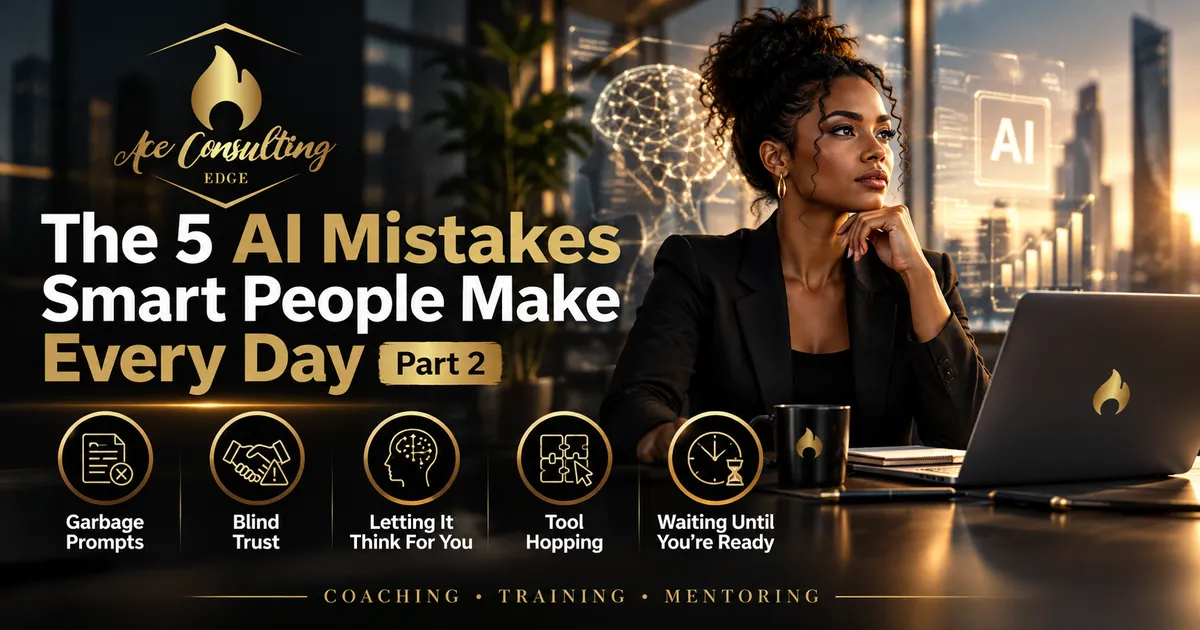
The 5 AI Mistakes I See Smart People Make Every Day (Part 2)
The 5 AI Mistakes I See Smart People Make Every Day (Part 2)
Smart people aren't falling behind because they lack intelligence. They're falling behind because they're making mistakes they don't even realize they're making.
Let's get straight to it.
Earlier this week, I gave you ten tools and systems to help you navigate this fast-moving AI world.
Today, I'm taking away your excuses.
Because here's what I see happening: smart, ambitious, hardworking people have access to some of the most powerful technology ever created.
They can research faster, organize better, create more, solve problems, and accomplish things that once required entire teams.
And yet, somehow, they're STILL stuck.
They're overwhelmed. Distracted. Constantly learning but rarely executing.
Why?
Because having powerful tools doesn't automatically make you powerful. Knowing how to use them does.
After more than 30 years of coaching and working with driven people, I've learned something about success: most people don't fail because they lack opportunities. They fail because they repeat behaviors that quietly work against their own progress.
AI hasn't changed that fundamental truth.
In fact, it's made those behaviors easier to see.
Here are five mistakes worth correcting before they cost you another year of progress.
1. Garbage Prompts — Stop Expecting Great Answers From Lazy Questions
Imagine walking into a meeting with an experienced business consultant and saying:
"Make my business successful."
Then you sit back, fold your arms, and wait for genius.
What exactly do you expect that consultant to do with that?
No background. No numbers. No objective. No understanding of your customers. Not even a clear definition of success.
Yet people approach AI this way EVERY SINGLE DAY.
They type:
"Write me a marketing plan."
"Help me increase sales."
"Make this better."
Then they complain that AI produces generic garbage.
Of course it does! You gave it almost nothing to work with.
Now compare that with this:
"Act as an experienced sales strategist. I own a residential plumbing company with five technicians. We generate roughly 40 leads per week but close only 25% of them. Our biggest challenge is converting phone inquiries into booked appointments. Help me identify three potential causes and develop a practical 30-day improvement plan. Ask me any important questions before making recommendations."
See the difference?
The second prompt gives AI a role, business context, numbers, a specific problem, and an expected outcome.
Most importantly, it invites the AI to ask questions rather than immediately pretending it knows everything.
That's how you turn a generic response into a useful working conversation.
THE ACE FIX:
Before you ask AI for anything important, give it five things:
Context. Goal. Constraints. Desired output. Questions it should ask you.
And remember: a detailed prompt doesn't guarantee a correct answer. It simply gives you a much better starting point.
Your challenge: Take one prompt you use regularly and rewrite it as though you're briefing a highly paid professional whose time you refuse to waste.
Because if you wouldn't give a human expert a sloppy briefing, why would you give one to AI?
2. Blind Trust — Confidence Is NOT the Same as Accuracy
This one worries me.
Not because AI makes mistakes.
Humans make mistakes too.
What worries me is how easily people confuse a beautifully written answer with a VERIFIED answer.
AI can produce a professional-looking explanation, complete with numbers, confident language, and what appear to be supporting facts.
And still be completely wrong.
It may misunderstand your question, use outdated information, miscalculate something, or produce a convincing claim with no reliable source behind it.
Yet people take that answer, copy it into an email, put it in a proposal, send it to a client, or make a business decision based on it.
WITHOUT CHECKING.
Let me ask you something.
If a new employee handed you a financial report containing numbers that could affect your business, would you approve it without reviewing the figures?
I certainly hope not.
So why would you suddenly abandon that standard because the information came from AI?
THE ACE FIX:
Create a simple rule for yourself:
The bigger the consequence, the stronger the verification.
A suggestion for a birthday invitation? Relax.
A social media headline? Review it.
A financial projection, contract, medical concern, important statistic, or major business decision?
Verify it using trustworthy sources and qualified professionals where appropriate.
Ask AI where a claim came from, but don't assume a citation is genuine just because it looks convincing. Open the source. Check what it actually says.
AI can help you reach an answer faster.
It cannot relieve you of responsibility for that answer.
Your reputation, your customers, and your decisions still belong to YOU.
3. Letting AI Think FOR You — The Most Dangerous Mistake of All
Here is where things get interesting.
The purpose of AI should be to make your thinking more effective.
Not to make your thinking unnecessary.
There's an enormous difference between those two approaches.
One strengthens your judgment.
The other risks weakening it through lack of use.
Think about someone who uses GPS for every single trip, even routes they've driven a hundred times.
Eventually, they may become so dependent on the directions that they stop paying attention to where they're going.
Technology is guiding them.
But they're no longer fully engaged in navigating.
The same thing can happen with your decision-making.
You ask AI what to think, what to write, what decision to make, what strategy to follow.
And then you accept the answer.
No challenge.
No independent reasoning.
No consideration of whether the recommendation actually fits your life, your customers, or your business.
That's not leadership.
That's outsourcing your judgment.
Here's what I'd rather see you do.
Tell AI:
"Here's my proposed strategy. Find the three biggest weaknesses. Challenge my assumptions. Tell me what could go wrong, what evidence would change your recommendation, and what alternatives I haven't considered."
Now we're talking!
You're not asking AI to replace your brain.
You're making it challenge your brain.
You're using it as a sparring partner.
And you know what happens when you consistently challenge your own assumptions?
You start noticing things you previously overlooked.
You ask better questions.
You make more thoughtful decisions.
THE ACE FIX:
Use AI to expand your perspective, test your reasoning, and expose weaknesses.
But make your own final judgment.
Never surrender the one tool that got you this far: YOUR MIND.
4. Shiny-Object Tool Hopping — You're Collecting Tools Instead of Building Results
A new AI tool launches.
Everybody talks about it.
You sign up.
You watch a tutorial.
You try it for two days.
Then another tool launches.
Suddenly, the first one is forgotten.
Another subscription. Another login. Another learning curve.
And another unfinished project.
Sound familiar?
Here's the uncomfortable part.
Sometimes, exploring new technology feels remarkably similar to making progress.
You're researching.
You're experimenting.
You're staying informed.
You're busy.
But being busy and being productive are two VERY different things.
Let me put it in language I use when coaching salespeople.
Imagine a salesperson who buys a new suit every week, changes their sales script every three days, switches companies every month, and spends hours studying what the top performers are doing.
But barely speaks to any customers.
Would you call that person productive?
Of course not.
They've confused preparing to perform with actually performing.
AI tool hopping is often the same problem wearing a technological costume.
Now, don't misunderstand me.
Exploring new tools can be valuable. Sometimes a genuinely better product comes along, and switching makes perfect sense.
But switching should be a deliberate decision based on results, not a reaction to every exciting headline.
THE ACE FIX:
Choose a small group of tools that solve real problems in your life or business.
Learn them.
Use them.
Measure whether they're helping.
And only replace them when you've identified a specific reason to do so.
Depth before novelty. Results before excitement.
Stop dating around.
Pick your stack and commit long enough to discover what it can actually do.
5. Waiting Until You're "Ready" — The Most Expensive Excuse
"I'll start using AI when I understand it better."
"I need to watch a few more tutorials."
"I'm waiting until I find the perfect tool."
"I don't want to mess anything up."
I've heard versions of these excuses for more than three decades, long before AI entered the conversation.
Different technology.
Same human behavior.
Fear dressed up as preparation.
Perfectionism disguised as high standards.
And procrastination pretending to be patience.
Here's something I've learned from training salespeople, coaching business owners, and watching people work toward difficult goals.
Confidence usually doesn't arrive BEFORE action. It develops THROUGH action.
You don't become comfortable having difficult conversations by studying conversations forever.
You become comfortable by having them.
You don't learn to swim by standing at the edge of the pool reading about water.
Eventually, you have to get in.
And you don't learn to use AI effectively by endlessly watching other people use it.
You have to start.
Will your first prompts be imperfect?
Absolutely.
Will you get disappointing answers?
Of course.
Will you sometimes make mistakes and need to correct them?
You bet.
That's called learning.
But here's the distinction: starting before you're perfect doesn't mean being careless.
Experiment with low-risk tasks first. Practice. Review the output. Improve your process. Keep sensitive information protected.
THE ACE FIX:
Choose ONE useful task you've been postponing.
Something real.
A weekly report. A customer email template. An organized plan. A brainstorming session for a business challenge.
Use AI to help you complete it.
Not someday.
TODAY.
Because perfectionism is often just procrastination wearing a nicer suit.
And the longer you wait for perfect conditions, the longer you delay your own progress.
Here's What Nobody Tells You About AI
Technology doesn't automatically create discipline.
It doesn't manufacture ambition.
It doesn't give you a sense of purpose.
And it certainly doesn't replace the responsibility you have to think, choose, and act.
What it can do is amplify your existing working habits.
If you're organized, curious, focused, and willing to learn, AI can help you accomplish more.
If you're constantly distracted, jumping between projects, avoiding hard decisions, and refusing to execute, more technology won't magically solve those problems.
You may simply become faster at doing things that don't move you forward.
That's why I've always believed that your state of mind determines how effectively you use the opportunities available to you.
And AI is one extraordinary opportunity.
But it still requires the same things success has always required:
Judgment. Discipline. Consistency. Curiosity. And ACTION.
The technology may be changing at extraordinary speed.
Human responsibility hasn't disappeared.
The real question isn't whether AI is powerful enough to help you.
It's whether you're developing the habits to use that power wisely.
YOUR ACTION PLAN — Five Mistakes. Five Corrections.
I'm not asking you to become an AI expert overnight.
I'm asking you to stop making avoidable mistakes.
1. UPGRADE YOUR PROMPTS. Take your three most frequently used AI requests and make them specific. Include your goals, context, and expectations.
2. BUILD A VERIFICATION HABIT. For every important claim, statistic, or recommendation, check the facts before relying on the answer.
3. CHALLENGE THE AI. This week, take one response and push back. Ask what could be wrong, what assumptions were made, and what alternative deserves consideration.
4. CLEAN UP YOUR TOOL STACK. Identify tools you're not using. Review whether to cancel unnecessary subscriptions and remove applications that provide no value. Don't delete anything holding important work without backing it up.
5. TAKE ONE REAL ACTION. Use AI to help with a meaningful task this week. Set a clear outcome, complete the work, and evaluate what actually improved.
No endless researching.
No waiting for the perfect moment.
No pretending that downloading another app is the same as making progress.
DO THE WORK.
Last Thought…
Two articles.
Ten tools to help you navigate the AI world.
Five mistakes that can stop you from making the most of them.
Fifteen ideas. And one responsibility: YOURS.
The people getting meaningful results from AI aren't necessarily smarter than you.
They've simply learned something valuable.
They don't need to know everything before taking the first step.
They start.
They question.
They improve.
And they keep moving.
Remember this:
You don't win by having access to the most powerful tools. You win by developing the mindset, judgment, and discipline to use the tools you have.
Now go build your stack.
Then go build your LIFE.
Which of these five mistakes are YOU making right now?
Be honest. Drop it in the comments — I read every one.
Ace 😊
If this article helped you see something differently, share it with someone who needs to stop preparing and start doing.